
For the second time in a year, a NASA camera aboard the Deep Space Climate Observatory satellite captured a 'lunar photobomb' -- a stunning view the Moon as it moved in front of the sunlit side of Earth, crossing over the Indian and Pacific oceans.

On December 1and 2, flood-ravaged Chennai received more rainfall in 24 hours than it had seen on any day since 1901, according to the National Aeronautics and Space Administration.

NASA has released new global maps of Earth at night.

The image clicked on July 6 clearly shows desert sand structures, river systems and complex cloud patterns.
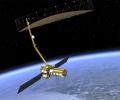
NISAR will not be used for surveillance and will be used to observe the earth.

Twice every 12 days, the NISAR satellite will scan nearly all of earth's land and ice surfaces to measure changes in the planet's ecosystems, growth and retreat of its land and sea ice, and deformation of its crust.

United States space agency NASA said it would launch a water-related satellite in collaboration with India's ISRO.

NASA has released the first-ever 360-degree panoramic images of the Sun. Two Solar Terrestrial Relations Observatory satellites, launched in 2006, have gradually been drifting apart -- one in front of the Earth in its orbit, the other lagging behind.
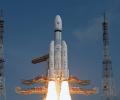
A mission to study the Sun, and launching a climate observation satellite, a test vehicle as part of Gaganyaan human space flight programme and an Indo-US synthetic aperture radar.

A NASA satellite, orbiting one million miles away, has captured stunning images of the Moon passing the Earth's sunlit side, which show the 'dark side' of the lunar body that is never visible from our planet.

National Aeronautics and Space Administration's newest solar observatory has captured a colossal coronal mass ejection erupting from the sun in extraordinary detail. According to the space agency, during the time of the ejection observed on May 9, a curtain of solar material erupted outwards at speeds of 1.5 million miles per hour.

Planet Nine, if it exists, is somewhere between 6-10 times the mass of Earth, and it may have an orbit that takes it around the sun once every 1,500 Earth years or more.

The details of the transition from defined rays in the corona, the Sun's upper atmosphere, to the solar wind have been, until now, a mystery.
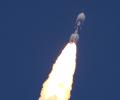
India's first solar mission, if successful, will showcase ISRO's ability to explore the cosmos, explains Kumar Abishek.

ISRO chairman S Somanath said the success gave the space agency "greater confidence," as the GSLV will be next deployed in the NISAR mission, a collaborative effort with the US' NASA.

Just over 22 minutes into the flight, the rocket put Astrosat into orbit at an altitude of 650 km above the earth

The new organism -- Solibacillus kalamii -- was found on the filters of the International Space Station.

The new, "fluffy" planet has been named 'WASP-193b' and was found to be located about 1,200 light years away from Earth, roughly equivalent to 10,800 trillion kilometres.

Back in 1958, when the 31-year-old Parker suggested that the charged particles streamed continuously from the Sun and fill up the space, the scientific community refused to believe him.

Here are some interesting facts about this newly discovered planet.

The new year will witness two unmanned missions under the "Gaganyaan" project, deep ocean exploration project, "Samudrayaan" and many more.

In a once-in-a-million-years encounter, a comet, the size of a small mountain, flew past Mars on Sunday.

A NASA spacecraft has captured a solar filament which appears as a dark line snaked across the lower half of the sun.

To celebrate the 25th anniversary of the Hubble Space Telescope's lift-off from Earth on April 24, here are some of the cosmic wonders it has captured over its lifetime.

China is frantically giving finishing touches to world's largest radio telescope designed to find signs of alien life following NASA's recent discovery of 'Earth 2.0' with the planet-hunting Kepler space telescope.
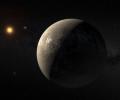
Prathmesh Kher/Rediff.com recalls how a planetary mission became interstellar in scope with the addition of a simple gold-plated disk.

The ISRO is looking at Mangalyaan-2, a follow-on mission to Mars, and launching two satellites that would look at Venus and explore asteroids.

The researchers, led by Matias Jones of the Pontifical Catholic University of Chile, used the 1.5 m telescope at the Cerro Tololo Inter-American Observatory and the 2.2 m telescope at La Silla observatory in Chile, and the 3.9 m Anglo-Australian telescope in Australia.

After stripping Pluto of planet status in 2006, some astronomers want to reclassify it once again, says Devangshu Datta.

India, with its demonstrated capabilities of undertaking low cost high value inter-planetary travel, offers great opportunities for NASA to work with.

Astronomers have imaged in unprecedented detail a distant galaxy near the edge of the universe and found that it is forming stars hundreds to thousands of times faster than the Milky Way.

International scientists said they have glimpsed the first direct evidence of gravitational waves, which Albert Einstein predicted a century ago.

It has already tasted success with the moon mission and Mangalyaan. Is man in space the next frontier for ISRO?
